
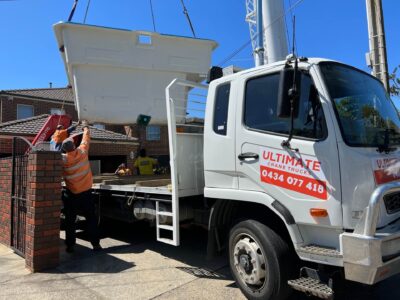
For lifting projects where mobility, setup speed, and site access are critical, trailer-mounted cranes and truck-mounted cranes emerge as the top two contenders. However, while both offer mobile lifting capabilities; their design, functionality, and applications differ significantly. Selecting the wrong choice can lead to project delays or inflated logistics costs.
So, how do you know which one is best for your project?
In this article, our experts at Ultimate Crane Trucks will break down the differences between these two crane types and compare them across key performance factors, facilitating the decision-making process.
What is a Truck-Mounted Crane?
A truck-mounted crane is a fully integrated lifting unit that combines a hydraulic crane with a road-registered truck chassis. This setup offers excellent mobility and operational readiness, particularly for jobs requiring fast setup and access to confined or built-up environments.
In Australia, truck-mounted cranes are typically built on rigid 6×4 or 8×4 trucks, with lifting capacities ranging from 5 tonne-metres up to 100+ tonne-metres, depending on crane type and boom length. Many truck-mounted cranes feature HIAB-style articulating (knuckle boom) cranes, which allow precise, multi-angle positioning in constrained areas.
Key Advantages:
- Single-unit operation: Transport and lifting in one vehicle streamlines logistics
- Urban compatibility: Narrow chassis and folding booms allow access to tight or height-restricted areas
- High mobility: Ideal for projects requiring frequent site changes across metropolitan or regional zones
- Cost control: Reduced need for escort vehicles, additional operators, or lengthy crane setup
What is a Trailer-Mounted Crane?
A trailer-mounted crane is a standalone lifting unit mounted on a towable trailer, typically hauled by a separate prime mover or heavy-duty vehicle. Unlike truck-mounted cranes, these have separate transport and lifting functions, offering increased flexibility in payload capacity and crane reach.
These cranes can also be permanently fixed to the trailer or integrated into semi-trailers designed to carry loads and lift them upon arrival.
In Australia, trailer-mounted cranes are less common on urban construction sites. However, they are regularly used in industrial logistics, rural infrastructure, and modular building transport.
Using these machines also requires oversize permits or escort vehicles for certain setups in line with NHVR regulations.
Key Advantages
- Greater payload flexibility: Trailer deck can carry heavier or longer items than rigid trucks
- Specialised crane options: Ability to attach higher-capacity or long-reach cranes not feasible on truck chassis
- Independent transport and crane scheduling: Allows transport and lifting tasks to be split across different teams
- Reduced wear on lifting equipment: The Crane is used only at the point of need, extending its service life
Truck-Mounted vs Trailer-Mounted Cranes: A Comparison
Deciding between a truck-mounted and a trailer-mounted crane requires careful consideration. The best choice depends on how each type aligns with your project’s logistics, site constraints, and lifting requirements. Below is a breakdown across critical factors:
Mobility
Truck-mounted cranes are highly mobile and road-legal as a single unit. Projects that require quick mobility between multiple sites or in tight urban environments would benefit from this mobility.
For example, a telecommunications company installing communication towers across metropolitan Melbourne might opt for a truck-mounted crane for its ability to access narrow streets and lift equipment to specific heights without needing a complex setup.
Trailer-mounted cranes are less agile as they require towing by a separate vehicle. However, they excel in open environments where space isn’t a constraint, such as in mining operations in rural areas.
Setup time
Setting up a truck-mounted crane usually takes minutes, especially if no additional exterior support is needed on-site.
Trailer-mounted cranes, on the other hand, require more time to set up due to stabilisation and site preparation. The site might need to be levelled and the crane stabilisers set up, taking up to an hour or more before lifting can begin.
Take note, however, that current onsite conditions can vary from pre-assessment conditions and potentially affect the setup time of both cranes.
Lifting capacity
Truck-mounted cranes are ideal for moderate lifts (2–20 tonnes). They work well for projects such as delivering and installing HVAC units or lifting steel beams at mid-rise construction sites.
When handling larger loads, such as modular homes, heavy equipment, or large steel structures, a trailer-mounted crane is more effective. For example, a solar farm installation project in a remote part of Victoria may use a trailer-mounted crane to place large solar panels onto frames.
Boom reach
Truck-mounted cranes typically have a boom reach of up to 15 – 24 metres. However, bigger units can reach as high as 60m. This reach is enough to lift materials from ground level to the roof without the need for additional equipment.
Trailer-mounted cranes generally offer longer boom reaches, often exceeding 35 metres. This makes them ideal for tasks like lifting heavy, long beams at great heights.
Cost and operational efficiency
Renting truck-mounted cranes from reputable companies like Ultimate Crane Trucks is more cost-effective for projects that require frequent lifts or multiple site visits. The crane’s ability to work efficiently across multiple locations reduces the overall cost per lift.
Due to transport and setup requirements, the costs for a trailer-mounted crane are, of course, higher, making them ideal for large-scale, one-off lifts.
Compliance and permits
While there are several regulations governing the operation of a truck-mounted crane, the permits required for them are generally less than those required for trailer-mounted ones. The latter often require oversize permits and escort vehicles when operating on highways or urban roads.
Do keep in mind that if you’re planning to use a bigger-sized truck-mounted crane, you might also need the same kinds of permits.
Choose the Right Crane Type for Your Project
Choosing between a truck-mounted crane and a trailer-mounted crane ultimately comes down to your project’s unique requirements.
A truck-mounted crane is often the better option for urban projects and smaller, multi-site lifts. For heavy, oversized loads and large-scale lifting operations, a trailer-mounted crane will provide the capacity and reach required for these demanding tasks.
At Ultimate Crane Trucks, our truck-mounted crane is specifically designed for maximum efficiency and precision. Contact us today, and let’s get your project done with speed, safety, and reliability.


